Wednesday, October 17, 2012

Speedy Graphito - Technical Temptation

Speedy Graphito, City Love, Painting on Canvas
Street Art pioneer Speedy Graphito was born in Paris in 1961. Speedy Graphito began his art career in the 1980´s on the streets of Paris, creating dynamic paintings and street murals using spray paint and stencils.


Speedy Graphito, Toxic Game,
Screenprint Unique on Paper
Originally a graphic designer and art director, Speedy Graphito quickly established a distinct urban art style that incorporates schematic and charasmatic characters, cartoons and manga alongside contemporary commercial brands, logos, and iconic pop culture imagery. Speedy Graphito´s art is inspired by the virtual and physical urbanscape, but predominantly the barrage of advertising that dominates today´s consumer culture. Street Artist Speedy Graphito has become recognized and revered for his satirical exploration of commercialism, often turning a critical eye on our society through his pop graffiti art.
Speedy Graphito, Temptation,
Screenprint on Paper
Particularly influenced by the iconography of Disney characters and video games, street artist Speedy Graphito often turns a critical eye on our society, as his artworks feed off the collective memory of iconic imagery to create a new universal language. As an example, Speedy Graphito´s "Temptation 2011" features Disney´s Snow White enamored with the half–eaten logo of Macintosh Apple, creating a shrewd and satirical criticism of consumer seduction.

An astute representation of social communication in the internet era, Speedy Graphito's "Snow White" screenprint mirrors our media and technology dominant social intercourse. Our new social experience is saturated by both text and pictoral messages, echoing the layers of an inundated graffiti wall. The seduction is explicated beyond Snow White and the Apple Logo, but further distinguishes our mass enchantment with a technological world at our finger-tips - just a click away from satisfaction.  


Speedy Graphito, Money, Painting on Canvas
Speedy Graphito´s paintings, prints, and street art murals can be found worldwide. Already recognized in the international arena, Speedy Graphito´s Art is well known in France, England, USA, Belgium, India, Japan, Brazil, and Dubai, as well as major auction houses. Speedy Graphito has recently participated in a number of solo art exhibitions in Los Angeles Art Galleries, as well as exhibiting at the 2011 Miami Art Basel.

Denis Bloch Fine Art is pleased to offer original paintings, drawings, limited edition screenprints, and unique prints by Street Artist Speedy Graphito.

Thursday, June 7, 2012

Mr. Brainwash Biography


Mr. Brainwash ("MBW") is the pseudonym for the graffiti street artist Thierry Guetta.
Mr. Brainwash was born in France in 1966, and has become one of American's most popular 'street art' artists. Originally a videographer, Mr. Brainwash began his career in 1999 documenting the lives and artwork of various graffiti street artists such as Banksy and Shepard Fairey. Mr. Brainwash has collected hours of footage often risking his own neck following graffiti artists creating their street art.  

Shortly after his initial introduction to Banksy, Mr. Brainwash made the decision to transition from art lover to artist as depicted in the film “Exit Through the Gift Shop”. Mr. Brainwash soon graduated from a few hand drawn stickers to making giant sized paste-ups, and his iconic pop graffiti art is now seen on the streets and art galleries of New York and Los Angeles.

The film “Exit Through the Gift Shop” as well as Mr. Brainwash and his relationship with the street artist Banksy is shroud in great controversy and mystery. There has been debate over whether the documentary is genuine or a mockumentary, although Banksy answers "Yes" when asked if the film is real.

Mr. Brainwash - Tomato Spray
Mr. Brainwash's uniformly subversive style fuses historic pop imagery and contemporary cultural iconography to create his own pop art - graffiti hybrid. The development of this style has catapulted Brainwash to international stardom. Mr. Brainwash's first solo show 'Life is Beautiful' was held in Los Angeles in June 2008, showing over 100 artworks. In addition to Mr. Brainwash’s widely recognized iconic art images, Life is Beautiful featured larger than life art installations which included a 20-foot robot made of old televisions, and a life-size recreation of Edward Hopper's Nighthawks and a pyramid made from 20,000 books. Originally scheduled to open for only two weeks, the art exhibit was extended for three months, attracting more than 30,000 visitors.

Mr. Brainwash's graffiti -styled art has continued to garner recognition from art collectors and street art enthusiasts alike. In 2009, Mr. Brainwash collaborated with Madonna on her Greatest Hits album, creating the cover art for Celebration.
Mr. Brainwash - Love is the Answer

In 2010, Mr. Brainwash opened his second art exhibition ICONS in New York City. The show featured Mr. Brainwash’s paintings and silkscreens of world icons such as Madonna, Charlie Chaplin, and Albert Einstein, as well as portraits of music legends constructed of broken records and large-scale sculptural installations such as a giant boom box and a NYC cab in a life-sized Matchbox packaging. The sold-out art exhibition was extended until early May 2010. Not only were major art collectors acquiring Mr. Brainwash's paintings and prints but also prestigious auction houses. In the Fall of 2010 Mr. Brainwash made two significant auction sales for his unique paintings. The smaller of the two pieces featured a portraiture style depiction of model Kate Moss selling for $67,000. The larger piece continued Brainwash's fascination with Albert Einstein and featured the historic physicist in a front of a graffiti adorned wall holding a sign reading “Love is the Answer”. The work sold for well above the pre-auction estimates for $120,000.

Mr. Brainwash currently lives and works in Los Angeles.
Note:

An interesting note on Mr. Brainwash’s unique signature and authentication – Mr. Brainwash has a series of additions to his signature to help further authenticate his original artworks. On the back of every unique piece he stamps his thumb print and adds a numbered code from a dollar bill. The bill is then cut in two, one half is given to the owner of the piece and the other is kept at Mr. Brainwash’s estate for future authentication. Any unique piece sold by Denis Bloch Fine Art will be accompanied by a certificate of authenticity as well as the dollar bill.

Tuesday, December 27, 2011

Sam Francis – Space and Color

Sam Francis - Trietto II - Aquatint Print
“Painting is about the beauty of space and the power of containment.” – Sam Francis

Sam Francis with Wallse Ting in studio
American Abstract Artist Sam Francis was late to start his successful and brilliant career as a painter and printmaker. While serving as a pilot in the United States Air Force during WWII, Sam Francis suffered an injury that hospitalized him for several years. While recovering, Sam Francis began to paint over the side of his hospital bed to escape the mundane routine of the hospital as well as the pains of his aching body. Developing a love for art and finding an artistic voice was healing for Sam Francis, and the art created in this time had an astonishing remedial effect on Sam Francis’ mental and emotional state.

Sam Francis - Untitled SF345
Lithograph
Sam Francis’ experience as a pilot had a unique bearing on his paintings and prints, which often utilized aerial perspectives to communicate the silence of the skies. Sam Francis’ aerial approach to the canvas became paramount to his methodology as a painter, as well as a signature style for Sam Francis.

During the late 1940s, Sam Francis began producing and exhibiting his earliest abstract artworks. Francis was initially influenced by the work of the Abstract Expressionists, like Mark Rothko and Arshile Gorky, and Sam Francis incorporated many of their techniques and ideas in his art. Despite this influence, Sam Francis’ art was also in close dialogue with modern and contemporary French art. His references ranged from the Water Lilies of Claude Monet, which inspired many of Sam Francis ideas about atmosphere and space, to Pierre Bonnard and Henri Matisse, whose conceptions of pure color were particularly resonant with Francis.

Sam Francis - Pasadena Box (Plate 8)
Lithograph Print
While traveling to Japan during the 1950’s, Sam Francis became interested in Japanese calligraphy and art, particularly the Japanese use of negative space. Sam Francis was acutely aware of the dialogue between color and space on the canvas. In many of Sam Francis’ prints and paintings from the 1960’s the brushwork is relegated to the outer edges, leaving vast empty spaces in the center of each art piece. The negative space, or silence within Sam Francis’ art is as meaningful as Francis’ fluid brushwork of radiant color.

“Color is a kind of holy substance for me,” Francis said. “It’s the element in painting which I am most fascinated with. It is an element of painting which overcomes me. . . . Color in a way is a receptacle for a feeling and a way for you to hold it until understanding arrives or meaning is extracted.” Sam Francis’ artwork further investigated perceptions of light and color by contrasting glowing jewel tones with large areas of white. White in Sam Francis’ art does not function simply as a ground against which he applies color. Rather, the white areas are dynamically engaged in active communication with the colors. For Francis each color had a symbolic value: white corresponded to the infinite, blue to the cosmos and water, and yellow to the sun.

Sam Francis - Untitled - Monotype
Considered one of the premier colorists of the twentieth century, Sam Francis is best known for dramatic, lushly painted works comprised of vivid pools of color, thinly applied. Sam Francis has also been compared to Color Field artists on the basis of large, fluid sections of paint that seem to extend beyond the confines of the pictorial surface. Sam Francis’ art is a dynamic and sophisticated juxtaposition between color and space, a luminous conversation played out in strokes of lush color.

Visit our website for more available prints by Sam Francis.

Tuesday, September 6, 2011

A smARTer Investment

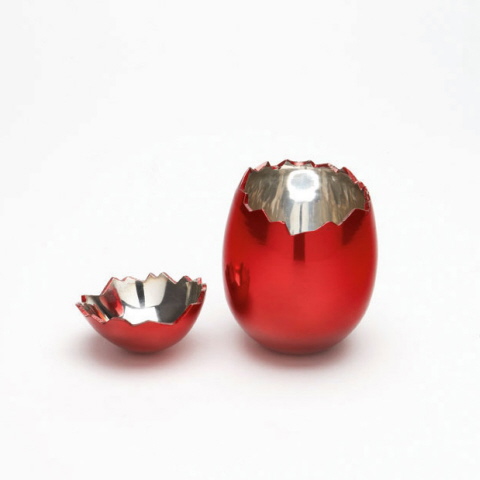
Jeff Koons, Cracked Egg (Red), 2008
If you’d added a few fine artworks to your portfolio over the last few years, instead of all those bank stocks, your retirement nest egg might be looking a little different right now.

Let’s face it, the stock market rollercoaster, particularly in the last month has left the average investor nauseous and contemplating getting off the ride all together (if not already). In many cases the market volatility has driven investors to alternative investment markets like gold and Fine Art.

Fine Art has been an attractive investment for centuries and is becoming increasingly recognized as it has outperformed more conservative investments over the last few decades. It is an alternative investment earning capital gains rather than a dividend.

Indeed, for the last ten years, the price index of all Fine Art works sold more than once worldwide has produced a nearly 11% annualized return, outperforming the Standard & Poor’s 500 index of large cap stocks and most other asset classes, including bonds and commodities.

Marc Chagall, Multiflore, 1974
Fine Art, including paintings, sculpture, original prints and photography is a very interesting long-term asset class. Indeed, investment-grade art enjoys a low correlation with other asset classes, including stocks and bonds, strengthening its case as a candidate for portfolio diversification. And some maintain they can act as an inflation hedge, since “real assets” (like gold) tend to rise in value while the value of money falls.
Since the end of World War II the value of Fine Art works has appreciated enormously. Quality works of art have proved to be a remarkable store of value. This is predominantly due to increasing rarity caused by an expanding demand from museums and collectors, and dwindling supplies.

Before you even think about putting down money, however, it’s important to educate yourself on the forces affecting the art market overall. The best advice is to talk to seasoned collectors and professionals in the industry. Go to the galleries and ask questions. Get involved with the museum and befriend the curator. An educated consumer is going to be best equipped to maneuver in this marketplace.

If, as it is more likely the case, you want to invest your money in something that you also like the look of,
(which I recommend!), make sure that your heart doesn’t rule your head and you buy something that looks pretty but is unlikely to ever accrue in value or worse yet decrease.

On that note, beware of galleries and dealers promoting artists with niche bubble markets. There is a reason we have not seen some very “popular” commercial artists in any major Contemporary Museums – the following of these types of artists is purely promotional, and their value is backed by the people marketing them, not by an actual global market. Over time these types of mega-marketed commercial artists will fall victim to the tastes of the market and will be virtually worthless.

Jim Dine, Fortress of the Heart, 1981-82
It is important to note that the high end of the market is not at the mercy of public taste. The art market has its blue-chip investments (museum artists) and these quality investments will bring a reliable return. Of course, the entry point can be higher. Artwork that emanates from more mature markets, such as Museum Class Master Paintings, can cost anywhere from $10,000 to many millions depending on the artist.


Picasso Linocuts featured at the MOMA 2009
The alternative is the investment in Museum Class Master Graphics or Original Prints with an entry point in the $1,000 level. Of course even great Prints are now expensive, but I’d recommend those! The best ones generally increase in value the most. From a return on investment standpoint, it’s also good advice to buy the best piece you can afford. The market has become much more selective, with an emphasis on quality.

Tuesday, June 21, 2011

Sonia Delaunay Biography: Textiles, Design, and Prints


Sonia Delaunay Original Print -
Composition with Semi-circles

Artist Sonia Delaunay-Terk was born in present day Ukraine on November 14th, 1885 under the surname Stern. At a young age Sonia Delaunay moved to St. Petersburg, where she was cared for by her mother's brother, Henri Terk, a successful and affluent Jewish lawyer. Henri Terk and his wife Anna adopted Sonia Delaunay in 1890 when she assumed the name Sonia Terk. Sonia Delaunay-Terk received a privileged upbringing with the Terks, traveling widely throughout Europe where Sonia Delaunay was introduced to art museums and art galleries.

Sonia Delaunay Etching -
Composition with Circles
When Sonia Delaunay was 18, she was sent to study art at the Academy of Fine Arts in Karlsruhe, Germany. Sonia Delaunay studied in at the Art Academy until 1905 when she decided to join the Modern Art movement at Montparnasse in Paris. Sonia Delaunay was deeply influenced by the post-impressionist art of Van-Gogh, Gauguin, and Henri Rousseau as well as the artists of the Fauves group including Henri Matisse.

During Sonia Delaunay’s first year in Paris Sonia Delaunay met, and married, German homosexual art gallery owner Wilhelm Uhde. It is assumed that Sonia Delaunay’s marriage to Uhde was a marriage of convenience to escape the demands of her parents, who disliked her artistic career. Through Uhde's gallery Sonia Delaunay gained entrance into the Parisian art world and benefitted from his connections, and Uhde masked his homosexuality through his public marriage to Sonia. Through her connections Sonia Delaunay met prominent artists of the modern art movement including: Pablo Picasso, Georges Braque, Georges Rouault, and Maurice de Vlaminck.

Sonia Delaunay met painter Robert Delaunay in early 1909. Sonia and Robert became lovers in April of the same year and it was decided that Sonia Delaunay and Uhde should divorce. The divorce was finalized in August 1910. In November of 1910 Sonia and Robert Delaunay were married. Sonia Delaunay was pregnant with their son Charles who was born on January 18, 1911. Sonia Delaunay made a patchwork quilt for Charles' crib, which is now in the collection of the Musee National d'Art Moderne in Paris. Sonia Delaunay’s quilt was created spontaneously and exemplifies Sonia Delaunay’s use of geometry and color in her textiles, paintings, and original prints.

Sonia Delaunay Aquatint -
Composition with Triangles
Contemporary art critics recognize this as the point where Sonia Delaunay moved away from perspective and naturalism in her art. Robert & Sonia Delaunay became associated with the development of Orphism, a highly abstract art movement which paralleled the geometry of Cubism but with a much brighter color palette. It is said that artist Paul Klee was so taken with Sonia Delaunay’s’ patterning of squares from a 1912 illustrated book, that they became an enduring feature in Klee’s own art.
During the 1910-1920s, Sonia Delaunay focused on bringing this new artistic lyricism into the world of design, transforming Art Deco fabrics into vibrant high fashion clothing, wall coverings, furniture textiles as well as, theatrical costumes. In 1917 Sonia Delaunay met Sergei Diaghilev, and Sonia Delaunay designed costumes for his productions of Cleopatra and Aida.
The Russian Revolution brought an end to the financial support Robert & Sonia Delaunay received from Sonia’s family in Russia, and a different source of income was needed. Sonia Delaunay made clothes for private clients and friends, and in 1923 created fifty fabric designs using geometrical shapes and bold colors, commissioned by a manufacturer from Lyon. Sonia Delaunay’s customers included Nancy Cunard, Gloria Swanson, Lucienne Bogaert and Gabrielle Dorziat.

In the 1930s, Sonia Delaunay returned her focus on painting, joining the Abstraction-Creation group in seeking to create an art based upon non-representational elements, often geometrical, and continuing to focus on color as central to painting. The group was trans-national, and including among its members: Jean Arp, Barbara Hepworth, Wassily Kandinsky and Piet Mondrian. In 1937 Sonia & Robert Delaunay collaborated on a mural for the Exposition Internationale des Arts et Techniques dans la Vie Moderne.

Sonia Delaunay Print -
Geometric Composition
In 1941 Robert Delaunay died of cancer. After Robert death, Sonia Delaunay continued to work and exhibit regularly as a painter & designer, turning often to printmaking including: etchings, lithographs, and pochoirs prints. In 1963 Sonia Delaunay donated 58 of her own works and 40 of Robert Delaunay’s to the Musee National d'Art Moderne, Paris. Sonia Delaunay became the first woman ever to be exhibited at the Louvre during her lifetime when the museum mounted an exhibition of the works in 1964.

In 1966 Sonia Delaunay printed Rythmes-Couleurs with 11 of her gouaches produced as pochoir prints, with texts by Jacques Damase. In 1969 Sonia Delaunay printed Robes poemes, also with texts by Jacques Damase containing 27 Sonia Delaunay prints.

Sonia Delaunay-Terk died in 1979 at the age of 94 with no regrets in her life.

Sonia Delaunay’s work in modern design included the use of geometric abstraction in the integration of furniture, fabrics, wall coverings, clothing, prints, lithographs, and etchings.

Sonia Delaunay was the subject of a recent Exhibition at the Cooper Hewitt National Design Museum.


Select Museum Collections:
Hermitage Museum, St. Petersburg
Museum of Modern Art, New York
Art Institute of Chicago, Chicago
Metropolitan Museum of Art, New York
Hirshhorn Museum & Sculpture Garden, DC
Tate Gallery, London
Reina Sofia National Museum, Madrid
Louvre, Paris