Showing posts with label Abstract Art. Show all posts

Saturday, December 7, 2013

Developing the Abstract - Frank Stella Biography

http://www.denisbloch.com/object.php?artist=Frank_Stella&title=Cantahar&artist_id=70&object_id=1043&cat=&medium_id=39&type_id=28
Frank Stella - Cantahar - 1998
American Abstract Artist Frank Stella was born in Malden, MA in 1936. Frank Stella is a highly regarded and collected Abstract artist known for his large–scale freestanding sculptures, architectural structures, and the most complex original prints ever realized in the medium of printmaking.
 
Frank Stella began painting in his sophomore year of high school at the Philips Academy in Andover, MA. Stella continued taking fine art courses at Princeton University, while majoring in history. While in school, Frank Stella visited numerous influential art exhibitions in the galleries of New York City. Frank Stella´s artistic development was directly shaped by the Abstract Expressionism of Jackson Pollock and Franz Kline, and in 1958 Stella moved to New York.  
http://www.tate.org.uk/art/artworks/stella-title-not-known-p78387
Frank Stella - Untitled - 1967
Upon moving to New York City, Stella reacted against the expressive use of paint by most painters of the abstract expressionist movement, instead finding himself drawn towards the "flatter" surfaces of Barnett Newman's art and the "Target" paintings by Jasper Johns. Stella gained early and immediate recognition in 1959 with his series of black pinstriped paintings that turned the gestural brushwork and existential angst of Abstract Expressionism on its head. Several of Frank Stella´s "black paintings" were included in major art exhibitions including: "Three Young Americans" at the Allen Memorial Museum at Oberlin College, and "Sixteen Americans" at the Museum of Modern Art (MOMA) in New York. The Black Paintings served as an important catalyst for Minimalist art of the 1960s.

In 1959 Frank Stella joined fine art dealer Leo Castelli´s gallery of artists, and in 1960 Stella began painting artworks in aluminum and copper paint as well. Stella´s art aesthetic steadily developed as he introduced a wider range of colors, typically arranged in straight or curved lines. Stella eventually created his paintings on shaped canvases (canvases in a shape other than the traditional rectangle or square), often being in L, N, U or T–shapes. In 1965 Frank Stella´s art was included in "The Shaped Canvas" at the Solomon R. Guggenheim Museum, and "Systemic Painting" of 1966. Stella´s shape canvases developed into more elaborate designs, in the Irregular Polygon series of 1967.

http://www.guggenheim.org/new-york/collections/collection-online/artwork/4003
Frank Stella - Harran II - 1967
In 1971 Stella developed his Protractor Series, in which arcs, sometimes overlapping, within square borders are arranged side–by–side to produce full and half circles painted in rings of concentric color. These paintings are named after circular cities he had visited while in the Middle East. Frank Stella´s Irregular Polygon canvases and Protractor Series further extended the concept of the shaped canvas. The shaped canvases took on even less regular forms in the Eccentric Polygon series as elements of collage were introduced. Stella´s artwork became more three–dimensional to the point where he started producing large, free–standing metal wall sculptures. As the 1970s and 1980s progressed, these became more elaborate and exuberant, marked by curving forms, Day–Glo colors, and scrawled brushstrokes. From the mid–1980s to the mid–1990s, Stella created a large body of paintings, sculptures, and original prints that responded in a general way to Herman Melville´s Moby–Dick.


http://www.denisbloch.com/object.php?artist=Frank_Stella&title=Extracts&artist_id=70&object_id=1170&cat=&medium_id=32&type_id=23
Frank Stella - Extracts - 1993
Starting in the mid–1960s Frank Stella launched his extended involvement with printmaking, working first with master printer Kenneth Tyler at Gemini G.E.L. Stella would continue to produce original prints for the duration of his artistic career, and in 1973 he had a print studio installed in his New York house. Frank Stella's abstract prints in lithography, screenprinting, etching and offset lithography had a strong impact upon printmaking as a fine art.


http://www.denisbloch.com/object.php?artist=Frank_Stella&title=Sanor&artist_id=70&object_id=925&cat=&medium_id=32&type_id=23
Frank Stella - Sanor - 1996

Additionally Frank Stella is heralded for his large free–standing sculptures for public spaces from the 1990´s including: the 10,000–square–foot mural for Toronto´s Princess of Wales Theatre; his 5,000–square–foot "Stella Project" which serves as the centerpiece of the theater and lobby of the Moores Opera House on the campus of the University of Houston, in Houston, TX; and Frank Stella´s monumental sculpture was installed outside the National Gallery of Art in Washington, D.C.

Frank Stella's virtually relentless experimentation has made him a key figure in American modernism, helping give rise to such developments as Minimalism, Post–Painterly Abstraction, and Color Field painting. In 2009 Frank Stella was awarded the National Medal of Arts by President Barack Obama, and in 2011 he was awarded the Lifetime Achievement Award in Contemporary Sculpture by the International Sculpture Center. Frank Stella continues to live and work in New York.

"A sculpture is just a painting cut out and stood up somewhere." – Frank Stella

Select Museum Collections:

Art Institute of Chicago
Guggenheim Museum, New York
Hirshhorn Museum and Sculpture Garden, DC
Museum of Fine Arts, Houston
Museum of Modern Art, New York
Norton Simon Museum, Pasadena
Whitney Museum of American Art, New York
San Francisco Museum of Modern Art
Fukuoka Art Museum, Japan
Museum of Contemporary Art, Los Angeles
Tate Gallery, London

Wednesday, May 8, 2013

ZAO WOU-KI


CELEBRATING THE ABSTRACT EXPRESSIONIST

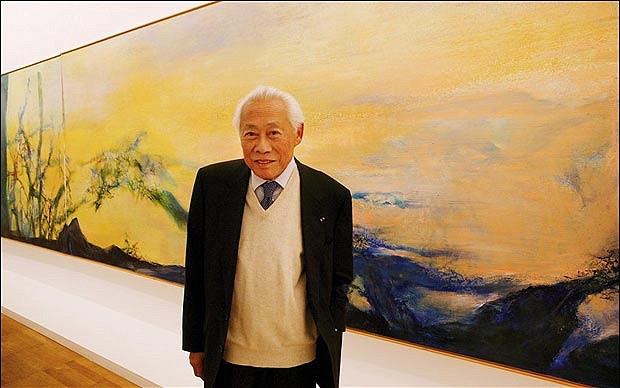
Zao Wou-ki with painting - Getty Image
Chinese – French Artist Zao Wou – ki was born in Beijing, China in 1921. Zao´s given name, "Wou – ki" (or "Wuji" in the standard Hanyu Pinyin romanization used in China), translates to "no boundaries." This perfectly encapsulates Zao Wou–ki as an artist, who was uniquely able to combine the cultures and aesthetic visions of France and China in his Fine art paintings, prints, etchings, and lithography.


Zao Wou-ki - Suite Beauregard - 1981 - Etching
Zao Wou – Ki went to school in Nantung, a small town north of Shanghai, where his father worked as a banker. Zao Wou–ki was considered a gifted pupil and he took great interest in literature and in Chinese and world history. Zao Wou – ki´s family was one of intellectuals who appreciated painting and fine art, and Wou–Ki would learn the traditional Chinese art of calligraphy from his grandfather.
From the age of ten Zao Wou–ki created drawings and paintings constantly. In 1935, at the age of fourteen, Zao Wou–Ki was admitted to the School of Fine Arts at Hangzhou, China. There Zao Wou – ki studied life drawing, oil painting, and also received instruction in the theories of calligraphy and western perspective. Despite the traditional teachings in accuracy and realism, Zao Wuji sought to capture the broad outlines and essence in his artwork compositions.

Zao Wou–Ki was appointed lecturer at the School of Fine Arts and in 1941 held his first art exhibition. According to Wou–Ki "To tell the truth, the [Paintings] I showed were strongly influenced by Matisse and Picasso. My harlequins recalled the ‘Blue Period´, my statue women the ‘Greek Period´." Indeed it was in the artworks of Cezanne, Matisse and Picasso that Zao Wou–Ki would find the vision he considered closest to nature. Inspired by his collection of postcards of reproduced French paintings and full page illustrations of Renoir, Modigliani, Cezanne, Matisse and Picasso artworks in American magazines, Zao Wou–ki developed his artistic approach.

 In 1947, the twenty–seven year old Zao Wou–Ki decided to leave China for Paris. Zao Wou–ki and his wife, Lan–Lan, sailed from Shanghai in early 1948 and after a voyage of 36 days, arrived in Paris, France where Zao Wou–Ki spent his first afternoon at the Louvre Art Museum. Zao Wou – ki settled in a studio near that of Alberto Giacometti; took French lessons; and visited and saw everything he could in Paris. The city inspired him and Zao Wou–ki easily frequented a circle of international artists, writers and intellectuals. While in Paris, Zao Wou–ki acquainted himself with European Lyrical Abstraction, a movement of postwar French artists pursuing free–form abstract expression through painting.

In 1949, Zao Wou–ki began making art prints after learning the technique of lithography at the Atelier Desjobert. The lithograph medium delighted Zao Wou – ki ––"The idea of throwing color on a large white stone, like on China paper, pleased me…," and Zao Wou–ki´s print experiments became lithographic masterpieces. In 1950 Zao Wou–ki published his prints accompanied by poems from celebrated poet Henri Michaux in 1950.

Zao Wou-ki - Flore et Faune - 1951 - Etching
Zao Wou–ki´s collaboration with Henri Michaux pushed him to review his Indian ink techniques and his roots in Chinese traditional drawing. Upon discovering Paul Klee´s paintings in 1951, Zao Wou–ki began to incorporate ideograms into his paintings, drawings, and prints. Zao Wuji still painted figurative elements, however, before he definitively committed to an Abstract painting aesthetic in 1953, inspired by archaic Chinese characters. Zao Wou–Ki had unknowingly come full circle back to traditional Chinese calligraphy – carefully drawing out each character with great passion and emotion.

Zao Wou-ki - Éloge des choses extrêmement légères - 1993 - Etching
Zao Wou–Ki travelled extensively in the 1950–1960s discovering and exhibiting in Italy, Spain, the United States, Japan, Greece, Switzerland and England. In 1950 Zao participated for the first time in the Salon de Mai, at which he was to exhibit regularly every year after that. Zao Wou–ki´s would befriended artists such as Rufino Tamayo and Joan Miro, as well as, architect I.M. Pei. In 1993 he was appointed Commander of the Legion of Honor by the President of France and the following year was awarded the Premium Imperial Award of Painting in Japan.
Zao Wou-ki - Village en fête - Oil on canvas - 1954

Zao Wou – ki was regarded as one of foremost Chinese Contemporary painters of the 20th century.By the end of his life Zao Wou–ki had stopped producing new artworks due to health problems. He died on April 9th, 2013 at his home in Switzerland.

"How to represent the wind? How to paint emptiness? And the light, its brightness, its purity? I did not want to reproduce but to juxtapose forms, to assemble them in order to find in them the whispering wind over still water." ~ Zao Wou–ki

Select Museum Collections:
Metropolitan Museum of Art, NYC
Guggenheim Museum, NYC
Georges Pompidou Centre, Paris
Musee des Beaux–Arts, Montreal
Art Institute of Chicago, IL
Museum of Modern Art, NYC
Museo de Arte Moderno, Mexico
National Institute of Fine Arts, Beijing
Fundacio Joan Miro, Barcelona

Tuesday, December 27, 2011

Sam Francis – Space and Color

Sam Francis - Trietto II - Aquatint Print
“Painting is about the beauty of space and the power of containment.” – Sam Francis

Sam Francis with Wallse Ting in studio
American Abstract Artist Sam Francis was late to start his successful and brilliant career as a painter and printmaker. While serving as a pilot in the United States Air Force during WWII, Sam Francis suffered an injury that hospitalized him for several years. While recovering, Sam Francis began to paint over the side of his hospital bed to escape the mundane routine of the hospital as well as the pains of his aching body. Developing a love for art and finding an artistic voice was healing for Sam Francis, and the art created in this time had an astonishing remedial effect on Sam Francis’ mental and emotional state.

Sam Francis - Untitled SF345
Lithograph
Sam Francis’ experience as a pilot had a unique bearing on his paintings and prints, which often utilized aerial perspectives to communicate the silence of the skies. Sam Francis’ aerial approach to the canvas became paramount to his methodology as a painter, as well as a signature style for Sam Francis.

During the late 1940s, Sam Francis began producing and exhibiting his earliest abstract artworks. Francis was initially influenced by the work of the Abstract Expressionists, like Mark Rothko and Arshile Gorky, and Sam Francis incorporated many of their techniques and ideas in his art. Despite this influence, Sam Francis’ art was also in close dialogue with modern and contemporary French art. His references ranged from the Water Lilies of Claude Monet, which inspired many of Sam Francis ideas about atmosphere and space, to Pierre Bonnard and Henri Matisse, whose conceptions of pure color were particularly resonant with Francis.

Sam Francis - Pasadena Box (Plate 8)
Lithograph Print
While traveling to Japan during the 1950’s, Sam Francis became interested in Japanese calligraphy and art, particularly the Japanese use of negative space. Sam Francis was acutely aware of the dialogue between color and space on the canvas. In many of Sam Francis’ prints and paintings from the 1960’s the brushwork is relegated to the outer edges, leaving vast empty spaces in the center of each art piece. The negative space, or silence within Sam Francis’ art is as meaningful as Francis’ fluid brushwork of radiant color.

“Color is a kind of holy substance for me,” Francis said. “It’s the element in painting which I am most fascinated with. It is an element of painting which overcomes me. . . . Color in a way is a receptacle for a feeling and a way for you to hold it until understanding arrives or meaning is extracted.” Sam Francis’ artwork further investigated perceptions of light and color by contrasting glowing jewel tones with large areas of white. White in Sam Francis’ art does not function simply as a ground against which he applies color. Rather, the white areas are dynamically engaged in active communication with the colors. For Francis each color had a symbolic value: white corresponded to the infinite, blue to the cosmos and water, and yellow to the sun.

Sam Francis - Untitled - Monotype
Considered one of the premier colorists of the twentieth century, Sam Francis is best known for dramatic, lushly painted works comprised of vivid pools of color, thinly applied. Sam Francis has also been compared to Color Field artists on the basis of large, fluid sections of paint that seem to extend beyond the confines of the pictorial surface. Sam Francis’ art is a dynamic and sophisticated juxtaposition between color and space, a luminous conversation played out in strokes of lush color.

Visit our website for more available prints by Sam Francis.