Showing posts with label Museum of Modern Art. Show all posts

Saturday, September 27, 2014

Rauschenberg - Signs of the Times

Robert Rauschenberg - Signs - 1970 - Screenprint Signed

Robert Rauschenberg’s“Signs” 1970, is one of the most sought after Rauschenberg screenprints because of the artwork’s incredible iconographic imagery and historical significance. "Signs" was originally commissioned by Time Magazine, with the intention that it would be used as the January edition cover for the year 1970. After considering the final composition, the executives at Time Magazine found the piece was more politically charged than they had hoped and decided against using it. It was felt that the composition, though stunning, was more of a recapitulation of the 1960’s than a welcome to the new decade.

After the dismissal by Time Magazine, Robert Rauschenberg’s trusted dealer Leo Castelli convinced him to print a limited edition screenprint of “Signs”. The edition was published by Leo Castelli in New York in an edition of 250; each signed, dated ‘70’, and numbered in pencil.

“Signs” is an astounding collage encompassing the monumental events and people of 1960’s America. Rauschenberg masterfully juxtaposes scenes of innovation like the moon landing with the destructive violence of the war in Vietnam and the civil rights movement. The revolutionary nature of the era is pronounced through the images of peace protestors at the top, whose rallies for change and peace are echoed by the voice of Janis Joplin deeply singing into her microphone. The iconic leaders of the era including JFK and his brother Bobbie Kennedy challenge the divisive violence of the wars and civil unrest, even as their forms and images transition into the faces of martyrs. The “Signs” of this transformative decade are woven seamlessly by Rauschenberg, and the screen print is known as one of his most important works of art.

National Gallery of Australia


DENIS BLOCH FINE ART is please to offer a number of original
signed prints by Robert Rauschenberg.

Click Here To View The Collection!

Saturday, December 7, 2013

Developing the Abstract - Frank Stella Biography

http://www.denisbloch.com/object.php?artist=Frank_Stella&title=Cantahar&artist_id=70&object_id=1043&cat=&medium_id=39&type_id=28
Frank Stella - Cantahar - 1998
American Abstract Artist Frank Stella was born in Malden, MA in 1936. Frank Stella is a highly regarded and collected Abstract artist known for his large–scale freestanding sculptures, architectural structures, and the most complex original prints ever realized in the medium of printmaking.
 
Frank Stella began painting in his sophomore year of high school at the Philips Academy in Andover, MA. Stella continued taking fine art courses at Princeton University, while majoring in history. While in school, Frank Stella visited numerous influential art exhibitions in the galleries of New York City. Frank Stella´s artistic development was directly shaped by the Abstract Expressionism of Jackson Pollock and Franz Kline, and in 1958 Stella moved to New York.  
http://www.tate.org.uk/art/artworks/stella-title-not-known-p78387
Frank Stella - Untitled - 1967
Upon moving to New York City, Stella reacted against the expressive use of paint by most painters of the abstract expressionist movement, instead finding himself drawn towards the "flatter" surfaces of Barnett Newman's art and the "Target" paintings by Jasper Johns. Stella gained early and immediate recognition in 1959 with his series of black pinstriped paintings that turned the gestural brushwork and existential angst of Abstract Expressionism on its head. Several of Frank Stella´s "black paintings" were included in major art exhibitions including: "Three Young Americans" at the Allen Memorial Museum at Oberlin College, and "Sixteen Americans" at the Museum of Modern Art (MOMA) in New York. The Black Paintings served as an important catalyst for Minimalist art of the 1960s.

In 1959 Frank Stella joined fine art dealer Leo Castelli´s gallery of artists, and in 1960 Stella began painting artworks in aluminum and copper paint as well. Stella´s art aesthetic steadily developed as he introduced a wider range of colors, typically arranged in straight or curved lines. Stella eventually created his paintings on shaped canvases (canvases in a shape other than the traditional rectangle or square), often being in L, N, U or T–shapes. In 1965 Frank Stella´s art was included in "The Shaped Canvas" at the Solomon R. Guggenheim Museum, and "Systemic Painting" of 1966. Stella´s shape canvases developed into more elaborate designs, in the Irregular Polygon series of 1967.

http://www.guggenheim.org/new-york/collections/collection-online/artwork/4003
Frank Stella - Harran II - 1967
In 1971 Stella developed his Protractor Series, in which arcs, sometimes overlapping, within square borders are arranged side–by–side to produce full and half circles painted in rings of concentric color. These paintings are named after circular cities he had visited while in the Middle East. Frank Stella´s Irregular Polygon canvases and Protractor Series further extended the concept of the shaped canvas. The shaped canvases took on even less regular forms in the Eccentric Polygon series as elements of collage were introduced. Stella´s artwork became more three–dimensional to the point where he started producing large, free–standing metal wall sculptures. As the 1970s and 1980s progressed, these became more elaborate and exuberant, marked by curving forms, Day–Glo colors, and scrawled brushstrokes. From the mid–1980s to the mid–1990s, Stella created a large body of paintings, sculptures, and original prints that responded in a general way to Herman Melville´s Moby–Dick.


http://www.denisbloch.com/object.php?artist=Frank_Stella&title=Extracts&artist_id=70&object_id=1170&cat=&medium_id=32&type_id=23
Frank Stella - Extracts - 1993
Starting in the mid–1960s Frank Stella launched his extended involvement with printmaking, working first with master printer Kenneth Tyler at Gemini G.E.L. Stella would continue to produce original prints for the duration of his artistic career, and in 1973 he had a print studio installed in his New York house. Frank Stella's abstract prints in lithography, screenprinting, etching and offset lithography had a strong impact upon printmaking as a fine art.


http://www.denisbloch.com/object.php?artist=Frank_Stella&title=Sanor&artist_id=70&object_id=925&cat=&medium_id=32&type_id=23
Frank Stella - Sanor - 1996

Additionally Frank Stella is heralded for his large free–standing sculptures for public spaces from the 1990´s including: the 10,000–square–foot mural for Toronto´s Princess of Wales Theatre; his 5,000–square–foot "Stella Project" which serves as the centerpiece of the theater and lobby of the Moores Opera House on the campus of the University of Houston, in Houston, TX; and Frank Stella´s monumental sculpture was installed outside the National Gallery of Art in Washington, D.C.

Frank Stella's virtually relentless experimentation has made him a key figure in American modernism, helping give rise to such developments as Minimalism, Post–Painterly Abstraction, and Color Field painting. In 2009 Frank Stella was awarded the National Medal of Arts by President Barack Obama, and in 2011 he was awarded the Lifetime Achievement Award in Contemporary Sculpture by the International Sculpture Center. Frank Stella continues to live and work in New York.

"A sculpture is just a painting cut out and stood up somewhere." – Frank Stella

Select Museum Collections:

Art Institute of Chicago
Guggenheim Museum, New York
Hirshhorn Museum and Sculpture Garden, DC
Museum of Fine Arts, Houston
Museum of Modern Art, New York
Norton Simon Museum, Pasadena
Whitney Museum of American Art, New York
San Francisco Museum of Modern Art
Fukuoka Art Museum, Japan
Museum of Contemporary Art, Los Angeles
Tate Gallery, London

Thursday, June 7, 2012

Mr. Brainwash Biography


Mr. Brainwash ("MBW") is the pseudonym for the graffiti street artist Thierry Guetta.
Mr. Brainwash was born in France in 1966, and has become one of American's most popular 'street art' artists. Originally a videographer, Mr. Brainwash began his career in 1999 documenting the lives and artwork of various graffiti street artists such as Banksy and Shepard Fairey. Mr. Brainwash has collected hours of footage often risking his own neck following graffiti artists creating their street art.  

Shortly after his initial introduction to Banksy, Mr. Brainwash made the decision to transition from art lover to artist as depicted in the film “Exit Through the Gift Shop”. Mr. Brainwash soon graduated from a few hand drawn stickers to making giant sized paste-ups, and his iconic pop graffiti art is now seen on the streets and art galleries of New York and Los Angeles.

The film “Exit Through the Gift Shop” as well as Mr. Brainwash and his relationship with the street artist Banksy is shroud in great controversy and mystery. There has been debate over whether the documentary is genuine or a mockumentary, although Banksy answers "Yes" when asked if the film is real.

Mr. Brainwash - Tomato Spray
Mr. Brainwash's uniformly subversive style fuses historic pop imagery and contemporary cultural iconography to create his own pop art - graffiti hybrid. The development of this style has catapulted Brainwash to international stardom. Mr. Brainwash's first solo show 'Life is Beautiful' was held in Los Angeles in June 2008, showing over 100 artworks. In addition to Mr. Brainwash’s widely recognized iconic art images, Life is Beautiful featured larger than life art installations which included a 20-foot robot made of old televisions, and a life-size recreation of Edward Hopper's Nighthawks and a pyramid made from 20,000 books. Originally scheduled to open for only two weeks, the art exhibit was extended for three months, attracting more than 30,000 visitors.

Mr. Brainwash's graffiti -styled art has continued to garner recognition from art collectors and street art enthusiasts alike. In 2009, Mr. Brainwash collaborated with Madonna on her Greatest Hits album, creating the cover art for Celebration.
Mr. Brainwash - Love is the Answer

In 2010, Mr. Brainwash opened his second art exhibition ICONS in New York City. The show featured Mr. Brainwash’s paintings and silkscreens of world icons such as Madonna, Charlie Chaplin, and Albert Einstein, as well as portraits of music legends constructed of broken records and large-scale sculptural installations such as a giant boom box and a NYC cab in a life-sized Matchbox packaging. The sold-out art exhibition was extended until early May 2010. Not only were major art collectors acquiring Mr. Brainwash's paintings and prints but also prestigious auction houses. In the Fall of 2010 Mr. Brainwash made two significant auction sales for his unique paintings. The smaller of the two pieces featured a portraiture style depiction of model Kate Moss selling for $67,000. The larger piece continued Brainwash's fascination with Albert Einstein and featured the historic physicist in a front of a graffiti adorned wall holding a sign reading “Love is the Answer”. The work sold for well above the pre-auction estimates for $120,000.

Mr. Brainwash currently lives and works in Los Angeles.
Note:

An interesting note on Mr. Brainwash’s unique signature and authentication – Mr. Brainwash has a series of additions to his signature to help further authenticate his original artworks. On the back of every unique piece he stamps his thumb print and adds a numbered code from a dollar bill. The bill is then cut in two, one half is given to the owner of the piece and the other is kept at Mr. Brainwash’s estate for future authentication. Any unique piece sold by Denis Bloch Fine Art will be accompanied by a certificate of authenticity as well as the dollar bill.

Tuesday, September 6, 2011

A smARTer Investment

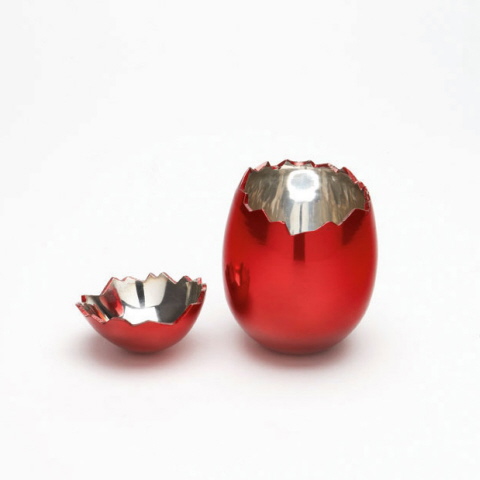
Jeff Koons, Cracked Egg (Red), 2008
If you’d added a few fine artworks to your portfolio over the last few years, instead of all those bank stocks, your retirement nest egg might be looking a little different right now.

Let’s face it, the stock market rollercoaster, particularly in the last month has left the average investor nauseous and contemplating getting off the ride all together (if not already). In many cases the market volatility has driven investors to alternative investment markets like gold and Fine Art.

Fine Art has been an attractive investment for centuries and is becoming increasingly recognized as it has outperformed more conservative investments over the last few decades. It is an alternative investment earning capital gains rather than a dividend.

Indeed, for the last ten years, the price index of all Fine Art works sold more than once worldwide has produced a nearly 11% annualized return, outperforming the Standard & Poor’s 500 index of large cap stocks and most other asset classes, including bonds and commodities.

Marc Chagall, Multiflore, 1974
Fine Art, including paintings, sculpture, original prints and photography is a very interesting long-term asset class. Indeed, investment-grade art enjoys a low correlation with other asset classes, including stocks and bonds, strengthening its case as a candidate for portfolio diversification. And some maintain they can act as an inflation hedge, since “real assets” (like gold) tend to rise in value while the value of money falls.
Since the end of World War II the value of Fine Art works has appreciated enormously. Quality works of art have proved to be a remarkable store of value. This is predominantly due to increasing rarity caused by an expanding demand from museums and collectors, and dwindling supplies.

Before you even think about putting down money, however, it’s important to educate yourself on the forces affecting the art market overall. The best advice is to talk to seasoned collectors and professionals in the industry. Go to the galleries and ask questions. Get involved with the museum and befriend the curator. An educated consumer is going to be best equipped to maneuver in this marketplace.

If, as it is more likely the case, you want to invest your money in something that you also like the look of,
(which I recommend!), make sure that your heart doesn’t rule your head and you buy something that looks pretty but is unlikely to ever accrue in value or worse yet decrease.

On that note, beware of galleries and dealers promoting artists with niche bubble markets. There is a reason we have not seen some very “popular” commercial artists in any major Contemporary Museums – the following of these types of artists is purely promotional, and their value is backed by the people marketing them, not by an actual global market. Over time these types of mega-marketed commercial artists will fall victim to the tastes of the market and will be virtually worthless.

Jim Dine, Fortress of the Heart, 1981-82
It is important to note that the high end of the market is not at the mercy of public taste. The art market has its blue-chip investments (museum artists) and these quality investments will bring a reliable return. Of course, the entry point can be higher. Artwork that emanates from more mature markets, such as Museum Class Master Paintings, can cost anywhere from $10,000 to many millions depending on the artist.


Picasso Linocuts featured at the MOMA 2009
The alternative is the investment in Museum Class Master Graphics or Original Prints with an entry point in the $1,000 level. Of course even great Prints are now expensive, but I’d recommend those! The best ones generally increase in value the most. From a return on investment standpoint, it’s also good advice to buy the best piece you can afford. The market has become much more selective, with an emphasis on quality.

Thursday, January 6, 2011

Tom Wesselmann - The Great American Nude

Monica with Motherwell, 1994 Serigraph
 "Personality would only be distraction from the simple fact of nudity. When I create physical details like lips or nipples, they are of importance for the erotic simplification. From the beginning I never gave them faces. A face gives personal touch to a sexual act, makes it a portrait act. And that, I don´t like at all."
                                                             – Tom Wesselmann

Tom Wesselmann, an American born painter, sculptor, and printmaker, was born in Cincinnati, Ohio in 1931. Tom Wesselmann studied psychology at the University of Cincinnati and also took art classes at the Art Academy of Cincinnati. Wesselmann had originally intended to become a cartoonist, but instead turned to painting.
 
Claire sitting Robe Half Off (Portfolio 90), 1993 Screenprint
 From 1956-1959 Tom Wesselmann continued his art studies at the Cooper Union in New York. While studying in New York, Wesselmann quickly informed himself about modern art by visiting the museums where the art of Robert Motherwell and Willem de Kooning made a lasting impact on Wesselmann. In 1957 Tom Wesselmann met Claire Selley, another Cooper Union student who was to become his friend, model, and later, his wife. After graduating, Tom Wesselmann became one of the founding members of the Judson Gallery, along with Marc Ratliff and artist Jim Dine.

In 1961 Tom Wesselmann began working on his series the Great American Nude. After a dream concerning the phrase "red, white, and blue", Tom Wesselmann decided to paint a Great American Nude in a palette limited to those colors and any colors associated with patriotic motifs such as gold and khaki. Tom Wesselmann’s Great American Nude series incorporated representational images with an accordingly patriotic theme, such as American landscape photos and portraits of founding fathers. Often these nudes were collaged from magazines and discarded posters, and were very large scale. Tom Wesselmann had his first solo art show at the Tanager Gallery in New York later that year, representing both the large and small Great American Nude collages.

Tom Wesselmann would soon emerge as one of the leading figures in American Pop Art along with fellow artists Roy Lichtenstein, Andy Warhol, Jim Dine and Alex Katz among others. Tom Wesselmann never liked his inclusion in American Pop Art, pointing out how he made an aesthetic use of everyday objects and not a reference to them as consumer objects.

Still Life with Petunias, Lilies and Fruit, 1988 Screenprint
In 1962, Tom Wesselmann participated in the New Realists art exhibition, which included art by the American Pop artists Jim Dine, Robert Indiana, Roy Lichtenstein, and Andy Warhol; and Europeans such as Arman and Christo. Wesselmann contributed two Still Life collages to the art exhibition. That year, Wesselmann had begun working on a new series of Still Lifes, experimenting with assemblage as well as collage.

Still Life with Liz (Portfolio 90), 1993 Screenprint
Tom Wesselmann's subjects are characteristically overtly sexual and Wesselmann is best known for his artworks where the nude becomes a depersonalized sex symbol set in a commonplace environment. Wesselmann would emphasize the woman's nipples, mouth and genitals with the rest of the body depicted in flat, unmodulated color.
Bedroom Blonde, 1997 Serigraph
During the late 1960s and early 1970s Tom Wesselmann worked constantly on the 'Bedroom Painting Series' in which elements of his 'Great American Nude', 'Still Lifes' and 'Seascapes' were juxtaposed. With these artworks Wesselmann began to concentrate on a few details such as hands, feet and breasts surrounded by flowers and objects. A major motivation of the 'Bedroom Paintings' was to shift the focus and scale of the attendant objects around a nude; these objects are relatively small in relation to the nude, but become major, even dominant elements when the central element is a body part.

Nude with Bouquet and Stockings, 1992 Screenprint
Tom Wesselmann was a highly inventive printmaker who favored the screenprint or serigraph, but also worked in unconventional formats, such as blind embossing and mixograph relief prints. These large scale prints mirror the boldness of Wesselmann’s unique paintings and embody the vitality, openness and free spirit of the sixties.

Following surgery for Wesselmann’s heart condition, Tom Wesselmann died on December 17, 2004.

Select Museum Collections:
Museum of Modern Art, New York
Art Institute of Chicago, Chicago
Tate Gallery, London
Haifa Museum, Israel
Smithsonian Institution, Washington DC
National Gallery of Art, Washington DC
Norton Simon Museum, Pasadena
Walker Art Center, Minneapolis

Tuesday, November 23, 2010

Le Repas Frugal (The Frugal Meal) by Pablo Picasso

Le Repas Frugal, 1904
Etching
Image: 46.3 x 37.7 cm

Poised between Pablo Picasso’s two most significant periods, Le Repas Frugal (The Frugal Meal) by Pablo Picasso represents a pivotal point in the Pablo Picasso’s printmaking oeuvre. As part of Picasso’s first suite/series of etchings, entitled La Suite des Saltimbanques, Le Repas Frugal contains elements of both Picasso’s Blue Period, marked by its melancholic introspection, and Picasso’s Rose Period, characterized by Pablo Picasso’s fascination with strolling acrobats or players. The bohemian life of those who lived on the edge of society was important to the young struggling Picasso as he too frequented the circus, the theater and music halls to escape from his impoverished lifestyle.


Les Pauvres (Saltimbanques Suite), 1905
Etching
23.6 x 18 cm
The Frugal Meal portrays an iconic image of a starving couple with a meager spread. The nearly skeletal man looks to the side as he comforts his female companion, perhaps denying their dire circumstance and blind with the hope of a better tomorrow. The woman stares with tired but tearless eyes, engaging an empathy that can only be acquired by a human diligently struggling to maintain dignity in the face of destitution. Other etchings from the Saltimbanques Suite also portray these scenes of insolvent social outsiders.


The Frugal Meal
displayed at the MOMA, April 2010
Executed in only two states, The Frugal Meal etching possesses a remarkable confidence and skill that belies Picasso's lack of formal training in printmaking. Having just learnt the etching technique from Ricardo Canals, a fellow resident of Montmartre, it is astonishing that Pablo Picasso produced this icon in the history of printmaking at the age of only twenty-three. Le Repas Frugal is considered one of Pablo Picasso’s masterpieces as a printmaker and was only Picasso’s second work created in the medium. The medium of etching would fascinate Pablo Picasso for the remainder of his life.

First printed in small numbers by the printer Eugene Delatre in 1905, The Saltimbanques etching plates were later acquired by art dealer and publisher Ambroise Vollard. Vollard had the fragile copper plates steel-faced and, in 1913, the edition of 250 was printed by Louis Fort. Together with an additional eleven drypoints and two etchings made by Picasso between 1904 and 1906, these early prints are commonly known as the Saltimbanques Suite.

Le Repas Frugal was recently exhibited at the Pablo Picasso Prints and Paintings exhibition at The Museum of Modern Art, New York. The Frugal Meal is a part of the permanent collections of the following museums and institutions:

The Metropolitan Museum of Art, New York
The Musee Picasso, Paris
The Museo Picasso, Barcelona


Wednesday, June 9, 2010

What Artists are the best to Collect for Investment?


There are essentially two kinds of artists that you can collect:
Artists we KNOW, and Artists we FEEL.


"Artists we know" are artists who have established themselves in the art market. If we were to liken these to stocks, these established artists would be considered “Blue Chips.” Obvious examples of these artists would be longtime recognized artists: Picasso, Chagall, Matisse, Warhol, Lichtenstein, etc. But also more and more living artists like David Hockney, Damien Hirst, Gerhard Richter, Peter Doig, Lucian Freud, Robert Indiana, Christo, etc.
Woman admiring Pablo Picasso prints at the MET Museum, New York

ArtistsWe Feel

"Artists we feel" are just that, artists that perhaps have not yet established themselves in the art scene, but we feel they are something special, and have great potential. These artists are comparable to a stock market “Start-up.” Of course there is no guarantee that these artists will ever reach Museum Status, but that is not why we invest in these artists, we invest in them because their works speaks to us on a visceral level, and we feel them with our hearts and souls.
Unknown Artist Exhibition, Los Angeles

Artists we know vs. Artists we feel

There is nothing wrong with spending some money on the artists we feel and love, just to have the pleasure of seeing them on our walls. My recommendation is to keep these kinds of investments low enough to enjoy without losing a lot, as money is hard earned, and a substantial price should only be paid for REAL VALUE with a strong future potential. If your purpose of collecting is investing then GO WITH WHAT YOU KNOW!
 Andy Warhol, Moonwalk, 1987 Screenprint

Wednesday, May 26, 2010

Why Should We Collect Original Prints?


 Affordability

The first and probably the most obvious reason for us to collect original prints is that they are simply more affordable than other mediums. The affordability also lends itself to better quality and quantity. For the same price as a small painting by an unknown or minor artist, you might be able to collect an important print by a major internationally famous artist such as Picasso, Chagall, Matisse, etc.

Picasso Exhibition at the Metropolitan Museum of Art, New York City 2010

A Picasso painting recently broke the world record and sold for more than 106 Million dollars, but you could acquire a museum quality Picasso graphic for under $20K.

You get more for your money, and the prospect of owning an original work by a master is more attainable than you realize.

Opportunity to Collect a Museum Quality Master
Picasso Exhibition at the Metropolitan Museum of Art, New York City 2010

Although just about every significant museum of modern art today acquires prints, one of the best examples of the benefits of print collecting was provided by Norton Simon, the industrialist and founder of his eponymous museum, who hoarded Picasso prints like they were going out of style. He acquired 710 Picasso prints but only five Picasso paintings. Clearly, he didn’t do it because, unlike many print collectors, they were the only Picassos he could afford, but rather because the print medium, especially in the hands of Picasso, the greatest print innovator of all time, gave rise to unique and breathtakingly beautiful artistic expressions.

Availability

Picasso Exhibition at the Metropolitan Museum of Art, New York City 2010
It is also good to note that because the original print medium is a medium of limited editions, the availability of these master prints is much better, although many popular or exceptional editions can be increasingly difficult to come by.