Saturday, December 7, 2013

Developing the Abstract - Frank Stella Biography

http://www.denisbloch.com/object.php?artist=Frank_Stella&title=Cantahar&artist_id=70&object_id=1043&cat=&medium_id=39&type_id=28
Frank Stella - Cantahar - 1998
American Abstract Artist Frank Stella was born in Malden, MA in 1936. Frank Stella is a highly regarded and collected Abstract artist known for his large–scale freestanding sculptures, architectural structures, and the most complex original prints ever realized in the medium of printmaking.
 
Frank Stella began painting in his sophomore year of high school at the Philips Academy in Andover, MA. Stella continued taking fine art courses at Princeton University, while majoring in history. While in school, Frank Stella visited numerous influential art exhibitions in the galleries of New York City. Frank Stella´s artistic development was directly shaped by the Abstract Expressionism of Jackson Pollock and Franz Kline, and in 1958 Stella moved to New York.  
http://www.tate.org.uk/art/artworks/stella-title-not-known-p78387
Frank Stella - Untitled - 1967
Upon moving to New York City, Stella reacted against the expressive use of paint by most painters of the abstract expressionist movement, instead finding himself drawn towards the "flatter" surfaces of Barnett Newman's art and the "Target" paintings by Jasper Johns. Stella gained early and immediate recognition in 1959 with his series of black pinstriped paintings that turned the gestural brushwork and existential angst of Abstract Expressionism on its head. Several of Frank Stella´s "black paintings" were included in major art exhibitions including: "Three Young Americans" at the Allen Memorial Museum at Oberlin College, and "Sixteen Americans" at the Museum of Modern Art (MOMA) in New York. The Black Paintings served as an important catalyst for Minimalist art of the 1960s.

In 1959 Frank Stella joined fine art dealer Leo Castelli´s gallery of artists, and in 1960 Stella began painting artworks in aluminum and copper paint as well. Stella´s art aesthetic steadily developed as he introduced a wider range of colors, typically arranged in straight or curved lines. Stella eventually created his paintings on shaped canvases (canvases in a shape other than the traditional rectangle or square), often being in L, N, U or T–shapes. In 1965 Frank Stella´s art was included in "The Shaped Canvas" at the Solomon R. Guggenheim Museum, and "Systemic Painting" of 1966. Stella´s shape canvases developed into more elaborate designs, in the Irregular Polygon series of 1967.

http://www.guggenheim.org/new-york/collections/collection-online/artwork/4003
Frank Stella - Harran II - 1967
In 1971 Stella developed his Protractor Series, in which arcs, sometimes overlapping, within square borders are arranged side–by–side to produce full and half circles painted in rings of concentric color. These paintings are named after circular cities he had visited while in the Middle East. Frank Stella´s Irregular Polygon canvases and Protractor Series further extended the concept of the shaped canvas. The shaped canvases took on even less regular forms in the Eccentric Polygon series as elements of collage were introduced. Stella´s artwork became more three–dimensional to the point where he started producing large, free–standing metal wall sculptures. As the 1970s and 1980s progressed, these became more elaborate and exuberant, marked by curving forms, Day–Glo colors, and scrawled brushstrokes. From the mid–1980s to the mid–1990s, Stella created a large body of paintings, sculptures, and original prints that responded in a general way to Herman Melville´s Moby–Dick.


http://www.denisbloch.com/object.php?artist=Frank_Stella&title=Extracts&artist_id=70&object_id=1170&cat=&medium_id=32&type_id=23
Frank Stella - Extracts - 1993
Starting in the mid–1960s Frank Stella launched his extended involvement with printmaking, working first with master printer Kenneth Tyler at Gemini G.E.L. Stella would continue to produce original prints for the duration of his artistic career, and in 1973 he had a print studio installed in his New York house. Frank Stella's abstract prints in lithography, screenprinting, etching and offset lithography had a strong impact upon printmaking as a fine art.


http://www.denisbloch.com/object.php?artist=Frank_Stella&title=Sanor&artist_id=70&object_id=925&cat=&medium_id=32&type_id=23
Frank Stella - Sanor - 1996

Additionally Frank Stella is heralded for his large free–standing sculptures for public spaces from the 1990´s including: the 10,000–square–foot mural for Toronto´s Princess of Wales Theatre; his 5,000–square–foot "Stella Project" which serves as the centerpiece of the theater and lobby of the Moores Opera House on the campus of the University of Houston, in Houston, TX; and Frank Stella´s monumental sculpture was installed outside the National Gallery of Art in Washington, D.C.

Frank Stella's virtually relentless experimentation has made him a key figure in American modernism, helping give rise to such developments as Minimalism, Post–Painterly Abstraction, and Color Field painting. In 2009 Frank Stella was awarded the National Medal of Arts by President Barack Obama, and in 2011 he was awarded the Lifetime Achievement Award in Contemporary Sculpture by the International Sculpture Center. Frank Stella continues to live and work in New York.

"A sculpture is just a painting cut out and stood up somewhere." – Frank Stella

Select Museum Collections:

Art Institute of Chicago
Guggenheim Museum, New York
Hirshhorn Museum and Sculpture Garden, DC
Museum of Fine Arts, Houston
Museum of Modern Art, New York
Norton Simon Museum, Pasadena
Whitney Museum of American Art, New York
San Francisco Museum of Modern Art
Fukuoka Art Museum, Japan
Museum of Contemporary Art, Los Angeles
Tate Gallery, London

Saturday, October 26, 2013

IS ART A GOOD INVESTMENT?


There are a number of indicators that prove that Fine Art, carefully selected, can be a lucrative commodity investment. Art is one of the most enticing hard asset investments, as collectors have created a hefty supply and demand system throughout the years.

According to Michael Moses, a retired New York University business school professor who co-
Marc Chagall
created the Mei Moses World All Art Index, over the past 60 years, the total return on fine art has been very similar to the return on the S&P 500-stock index. "If you use the last 30 years, the S&P substantially outperforms art," Moses says. "If you look at the most recent eight [to] 10 years, art has outperformed the S&P."


Another reason to consider investing in Art is that Fine Art has a proven track record as a good choice during hard times. Fine Art is more or less resilient to times of economic turmoil and trouble. It has outperformed during all of the wars of the 20th century, and has outperformed during the last 27 recessions. One of the biggest draws to this asset class is the fact that there is no underlying financial market to tinker with prices. There will never be a bad trade or a flash crash that will suddenly erase the value of your art investment. Though it is not a guarantee, Art also has the potential to appreciate with time.


The last and perhaps most rewarding aspect of collecting Fine Art are the emotional and aesthetic rewards. Because Art is a physical asset class, your investment is something that you can potentially enjoy every day.


COLLECTING THE RIGHT ARTIST

The greatest draw back to investing in fine art is the relative unpredictability of the performance an artist’s body of work might have. Like other markets there are artists and artworks that are highly unlikely to retain or develop future value, and so it is very important as a beginning collector to be highly selective of the artists you collect. The best advice is that you select artists with established markets. A blue-chip artist would have a major following, specifically by academic and museum interest. The Artist is your best indicator for potential value.

Pablo Picasso
Normally a museum artist like Picasso, Warhol, or Hockney would be out of range for the average
collector, but through the limited edition prints market you can attain these artists for a few thousand dollars as opposed to a few million. Many collectors and art dealers will tell you that originals will always perform better than prints, and this is half true. The original paintings for Pablo Picasso or Damien Hirst will always outperform the graphic artworks for these artists certainly, and if you have the capital to invest in high-level paintings of Museum Masters, I strongly recommend that this is the market you seek. However, an original painting by an immerging and unknown artist vs. an establish master’s print will not necessarily hold value or outperform the print. The performance of an original painting depends heavily on the current market and demand for the artist.


COLLECTING THE RIGHT PIECE

Aside from the Artist, other excellent indicators of future potential rest on the work itself. It is true that some compositions are simply more aesthetic than others. Some artworks may bear iconic images and characteristics of an artist’s specific period or style. It can be beneficial to research an artist’s backstory, as it can have a fair amount of weight in the resale value of a piece. Additionally if you are collecting sculptures or original prints the edition sizes can also play a major factor. When deciding what art to buy, the most important is that you enjoy and appreciate the art.


Wednesday, May 8, 2013

ZAO WOU-KI


CELEBRATING THE ABSTRACT EXPRESSIONIST

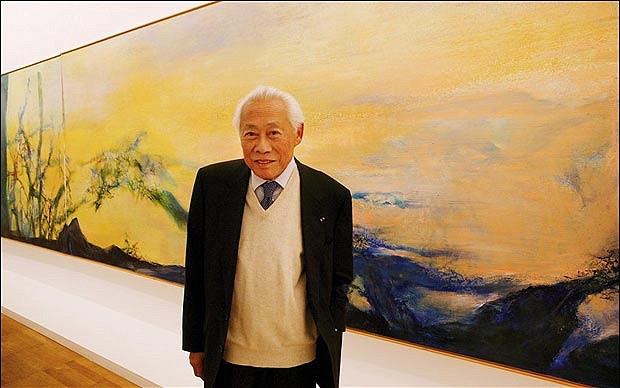
Zao Wou-ki with painting - Getty Image
Chinese – French Artist Zao Wou – ki was born in Beijing, China in 1921. Zao´s given name, "Wou – ki" (or "Wuji" in the standard Hanyu Pinyin romanization used in China), translates to "no boundaries." This perfectly encapsulates Zao Wou–ki as an artist, who was uniquely able to combine the cultures and aesthetic visions of France and China in his Fine art paintings, prints, etchings, and lithography.


Zao Wou-ki - Suite Beauregard - 1981 - Etching
Zao Wou – Ki went to school in Nantung, a small town north of Shanghai, where his father worked as a banker. Zao Wou–ki was considered a gifted pupil and he took great interest in literature and in Chinese and world history. Zao Wou – ki´s family was one of intellectuals who appreciated painting and fine art, and Wou–Ki would learn the traditional Chinese art of calligraphy from his grandfather.
From the age of ten Zao Wou–ki created drawings and paintings constantly. In 1935, at the age of fourteen, Zao Wou–Ki was admitted to the School of Fine Arts at Hangzhou, China. There Zao Wou – ki studied life drawing, oil painting, and also received instruction in the theories of calligraphy and western perspective. Despite the traditional teachings in accuracy and realism, Zao Wuji sought to capture the broad outlines and essence in his artwork compositions.

Zao Wou–Ki was appointed lecturer at the School of Fine Arts and in 1941 held his first art exhibition. According to Wou–Ki "To tell the truth, the [Paintings] I showed were strongly influenced by Matisse and Picasso. My harlequins recalled the ‘Blue Period´, my statue women the ‘Greek Period´." Indeed it was in the artworks of Cezanne, Matisse and Picasso that Zao Wou–Ki would find the vision he considered closest to nature. Inspired by his collection of postcards of reproduced French paintings and full page illustrations of Renoir, Modigliani, Cezanne, Matisse and Picasso artworks in American magazines, Zao Wou–ki developed his artistic approach.

 In 1947, the twenty–seven year old Zao Wou–Ki decided to leave China for Paris. Zao Wou–ki and his wife, Lan–Lan, sailed from Shanghai in early 1948 and after a voyage of 36 days, arrived in Paris, France where Zao Wou–Ki spent his first afternoon at the Louvre Art Museum. Zao Wou – ki settled in a studio near that of Alberto Giacometti; took French lessons; and visited and saw everything he could in Paris. The city inspired him and Zao Wou–ki easily frequented a circle of international artists, writers and intellectuals. While in Paris, Zao Wou–ki acquainted himself with European Lyrical Abstraction, a movement of postwar French artists pursuing free–form abstract expression through painting.

In 1949, Zao Wou–ki began making art prints after learning the technique of lithography at the Atelier Desjobert. The lithograph medium delighted Zao Wou – ki ––"The idea of throwing color on a large white stone, like on China paper, pleased me…," and Zao Wou–ki´s print experiments became lithographic masterpieces. In 1950 Zao Wou–ki published his prints accompanied by poems from celebrated poet Henri Michaux in 1950.

Zao Wou-ki - Flore et Faune - 1951 - Etching
Zao Wou–ki´s collaboration with Henri Michaux pushed him to review his Indian ink techniques and his roots in Chinese traditional drawing. Upon discovering Paul Klee´s paintings in 1951, Zao Wou–ki began to incorporate ideograms into his paintings, drawings, and prints. Zao Wuji still painted figurative elements, however, before he definitively committed to an Abstract painting aesthetic in 1953, inspired by archaic Chinese characters. Zao Wou–Ki had unknowingly come full circle back to traditional Chinese calligraphy – carefully drawing out each character with great passion and emotion.

Zao Wou-ki - Éloge des choses extrêmement légères - 1993 - Etching
Zao Wou–Ki travelled extensively in the 1950–1960s discovering and exhibiting in Italy, Spain, the United States, Japan, Greece, Switzerland and England. In 1950 Zao participated for the first time in the Salon de Mai, at which he was to exhibit regularly every year after that. Zao Wou–ki´s would befriended artists such as Rufino Tamayo and Joan Miro, as well as, architect I.M. Pei. In 1993 he was appointed Commander of the Legion of Honor by the President of France and the following year was awarded the Premium Imperial Award of Painting in Japan.
Zao Wou-ki - Village en fête - Oil on canvas - 1954

Zao Wou – ki was regarded as one of foremost Chinese Contemporary painters of the 20th century.By the end of his life Zao Wou–ki had stopped producing new artworks due to health problems. He died on April 9th, 2013 at his home in Switzerland.

"How to represent the wind? How to paint emptiness? And the light, its brightness, its purity? I did not want to reproduce but to juxtapose forms, to assemble them in order to find in them the whispering wind over still water." ~ Zao Wou–ki

Select Museum Collections:
Metropolitan Museum of Art, NYC
Guggenheim Museum, NYC
Georges Pompidou Centre, Paris
Musee des Beaux–Arts, Montreal
Art Institute of Chicago, IL
Museum of Modern Art, NYC
Museo de Arte Moderno, Mexico
National Institute of Fine Arts, Beijing
Fundacio Joan Miro, Barcelona

Wednesday, October 17, 2012

Speedy Graphito - Technical Temptation

Speedy Graphito, City Love, Painting on Canvas
Street Art pioneer Speedy Graphito was born in Paris in 1961. Speedy Graphito began his art career in the 1980´s on the streets of Paris, creating dynamic paintings and street murals using spray paint and stencils.


Speedy Graphito, Toxic Game,
Screenprint Unique on Paper
Originally a graphic designer and art director, Speedy Graphito quickly established a distinct urban art style that incorporates schematic and charasmatic characters, cartoons and manga alongside contemporary commercial brands, logos, and iconic pop culture imagery. Speedy Graphito´s art is inspired by the virtual and physical urbanscape, but predominantly the barrage of advertising that dominates today´s consumer culture. Street Artist Speedy Graphito has become recognized and revered for his satirical exploration of commercialism, often turning a critical eye on our society through his pop graffiti art.
Speedy Graphito, Temptation,
Screenprint on Paper
Particularly influenced by the iconography of Disney characters and video games, street artist Speedy Graphito often turns a critical eye on our society, as his artworks feed off the collective memory of iconic imagery to create a new universal language. As an example, Speedy Graphito´s "Temptation 2011" features Disney´s Snow White enamored with the half–eaten logo of Macintosh Apple, creating a shrewd and satirical criticism of consumer seduction.

An astute representation of social communication in the internet era, Speedy Graphito's "Snow White" screenprint mirrors our media and technology dominant social intercourse. Our new social experience is saturated by both text and pictoral messages, echoing the layers of an inundated graffiti wall. The seduction is explicated beyond Snow White and the Apple Logo, but further distinguishes our mass enchantment with a technological world at our finger-tips - just a click away from satisfaction.  


Speedy Graphito, Money, Painting on Canvas
Speedy Graphito´s paintings, prints, and street art murals can be found worldwide. Already recognized in the international arena, Speedy Graphito´s Art is well known in France, England, USA, Belgium, India, Japan, Brazil, and Dubai, as well as major auction houses. Speedy Graphito has recently participated in a number of solo art exhibitions in Los Angeles Art Galleries, as well as exhibiting at the 2011 Miami Art Basel.

Denis Bloch Fine Art is pleased to offer original paintings, drawings, limited edition screenprints, and unique prints by Street Artist Speedy Graphito.

Thursday, June 7, 2012

Mr. Brainwash Biography


Mr. Brainwash ("MBW") is the pseudonym for the graffiti street artist Thierry Guetta.
Mr. Brainwash was born in France in 1966, and has become one of American's most popular 'street art' artists. Originally a videographer, Mr. Brainwash began his career in 1999 documenting the lives and artwork of various graffiti street artists such as Banksy and Shepard Fairey. Mr. Brainwash has collected hours of footage often risking his own neck following graffiti artists creating their street art.  

Shortly after his initial introduction to Banksy, Mr. Brainwash made the decision to transition from art lover to artist as depicted in the film “Exit Through the Gift Shop”. Mr. Brainwash soon graduated from a few hand drawn stickers to making giant sized paste-ups, and his iconic pop graffiti art is now seen on the streets and art galleries of New York and Los Angeles.

The film “Exit Through the Gift Shop” as well as Mr. Brainwash and his relationship with the street artist Banksy is shroud in great controversy and mystery. There has been debate over whether the documentary is genuine or a mockumentary, although Banksy answers "Yes" when asked if the film is real.

Mr. Brainwash - Tomato Spray
Mr. Brainwash's uniformly subversive style fuses historic pop imagery and contemporary cultural iconography to create his own pop art - graffiti hybrid. The development of this style has catapulted Brainwash to international stardom. Mr. Brainwash's first solo show 'Life is Beautiful' was held in Los Angeles in June 2008, showing over 100 artworks. In addition to Mr. Brainwash’s widely recognized iconic art images, Life is Beautiful featured larger than life art installations which included a 20-foot robot made of old televisions, and a life-size recreation of Edward Hopper's Nighthawks and a pyramid made from 20,000 books. Originally scheduled to open for only two weeks, the art exhibit was extended for three months, attracting more than 30,000 visitors.

Mr. Brainwash's graffiti -styled art has continued to garner recognition from art collectors and street art enthusiasts alike. In 2009, Mr. Brainwash collaborated with Madonna on her Greatest Hits album, creating the cover art for Celebration.
Mr. Brainwash - Love is the Answer

In 2010, Mr. Brainwash opened his second art exhibition ICONS in New York City. The show featured Mr. Brainwash’s paintings and silkscreens of world icons such as Madonna, Charlie Chaplin, and Albert Einstein, as well as portraits of music legends constructed of broken records and large-scale sculptural installations such as a giant boom box and a NYC cab in a life-sized Matchbox packaging. The sold-out art exhibition was extended until early May 2010. Not only were major art collectors acquiring Mr. Brainwash's paintings and prints but also prestigious auction houses. In the Fall of 2010 Mr. Brainwash made two significant auction sales for his unique paintings. The smaller of the two pieces featured a portraiture style depiction of model Kate Moss selling for $67,000. The larger piece continued Brainwash's fascination with Albert Einstein and featured the historic physicist in a front of a graffiti adorned wall holding a sign reading “Love is the Answer”. The work sold for well above the pre-auction estimates for $120,000.

Mr. Brainwash currently lives and works in Los Angeles.
Note:

An interesting note on Mr. Brainwash’s unique signature and authentication – Mr. Brainwash has a series of additions to his signature to help further authenticate his original artworks. On the back of every unique piece he stamps his thumb print and adds a numbered code from a dollar bill. The bill is then cut in two, one half is given to the owner of the piece and the other is kept at Mr. Brainwash’s estate for future authentication. Any unique piece sold by Denis Bloch Fine Art will be accompanied by a certificate of authenticity as well as the dollar bill.