Showing posts with label Linocut. Show all posts

Thursday, November 20, 2014

What is a Proof? Artists Proofs and Printer's Proofs


Art collectors often ask our gallery about this topic, so today we are going to shed some light on the differences between different proofs and the printed edition.


What is a Limited Edition?
 
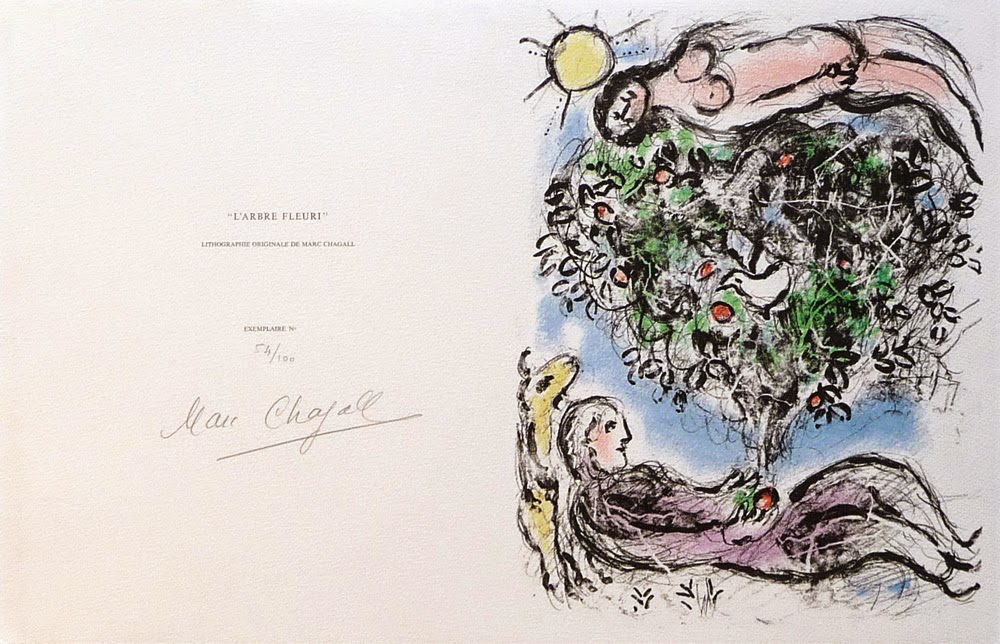
http://denisbloch.com/object.php/1285/marc-chagall-arbre-fleuri-lithograph-mourlot-915-louvre-catalogue
Marc Chagall "L'Arbre Fleuri I" - Lithograph - Edition of 100

When an artist prints a limited edition original print, such as a: lithograph, etching, aquatint, carborundum, screenprint, linocut, or woodcut, a set number of identical prints are made. This set number is the "Edition Size," and these will generally be numbered sequentially and hand-signed by the artist. An edition size can vary from extremely small editions of 5 to large editions of 1,000 or more. Open editions have an unknown or unlimited quantity of prints.


http://denisbloch.com/object.php/1104/joan-miro-la-magie-quotidienne-dupin-271-etchings-for-sale
Joan Miro "La Magie Quotidienne" - Etching - Edition of XV on Japon

Sometimes there are different editions printed on different kinds of paper. As an example there may be a regular edition on Arches paper with a limit of 100. These 100 prints are signed and numbered sequentially from 1/100 to 100/100.  In addition to this edition on Arches paper, a smaller edition of 15 are printed on Japon paper and numbered sequentially in roman numerals from I/XV to XV/XV and signed by the artist. This brings our total edition, to 115 prints + any additional proofs that may exist.

So What is a Proof?


A proof is usually an identical print to the regular edition, that is printed at the same time - but is not part of the numbered sequence. This is known as a "Proof Aside from the Edition," and these may or may not be hand-signed by the artist. In general with any edition printed there can be anywhere from 5-50 extra proofs aside from the edition.

Pablo Picasso "Farol (B. 945)" - Linocut - Epreuve d'artiste

Often these extra proofs are retained for the artist, otherwise known as an "Artist Proof". An artist proof can be annotated "A.P." for Artist Proof, or "E.A." in French "Epreuve d'artiste". Sometimes artists can additionally dedicate and gift a proof to a friend, collaborator, dealer, printer, or even family member.


Zao Wou-ki "En Attendant un Jour de Fete (250b)" - Etching - BAT with notes
A "Printer's Proof" designated as "P.P." is much the same, an extra proof made aside of the numbered edition retained by the printer or atelier. The "P.P." can also sometimes stand for "Publisher's Proof". The printer's proof is usually for approval by the master printer to ensure the quality of the printing, and can sometimes include notes and annotations about the printing process. The "BAT" or "Bon à Tirer" is a kind of printer's proof, normally use as a control example against which the other impressions are compared. Bon à Tirer is French for "Good to Print" and is also kept by the Printer or Atelier studio.


Sam Francis "Untitled I (TP)" - Etching - Color Trial Proof

 
Another kind of proof is the "Trial Proof" annotated "T.P." The trial proof is essentially a test proof, often to test colors or the final look of the composition. It is sometimes also referred to as a "working proof" by which the final composition of an edition has not yet been realized. Trial proofs are often thought of as unique prints as they are a one-of-a-kind version of the composition. Art historians, curators, and collectors view working proofs as especially desirable because of their rarity, and the insight they may give into the progress of the work.

http://denisbloch.com/object.php/556/marc-chagall-le-peintre-devant-le-village-mourlot-604
Marc Chagall "Le Peintre devant le Village II" - Lithograph - HC aside from edition

The last form of a "Proof" is the "H.C." which stands for the French term "Hors Commerce" or "Not for Sale". These are exactly as they sound, identical proofs to the regular edition that are not intended to be sold. Prints designated H.C. are often given to the project collaborators as a form of appreciation or partial payment.

Total Tirage

Marc Chagall Catalogue Raisonne Description

"Tirage", the French term meaning "output," is the total number of prints printed for an edition, including any proofs, APs, PPs, HC, and TPs. It is important to note that not every limited edition includes all of these, and the complete number of prints within a tirage are usually described in the artist's Catalogue Raisonné. Some artists and editions are catalogued very well and include full descriptions of the tirage, while others may have basic information only about the numbered edition.


For more information about printmaking and collecting original prints please visit our website:


Thursday, August 5, 2010

Picasso's Ceramics

Pablo Picasso is considered an artistic master, partly because Picasso’s oeuvre extends far beyond traditional painting methods, and encompasses all artistic mediums including: lithography, etching, linocuts, and even pottery. Picasso gleaned a particular joy in creating ceramics, as evidenced by Picasso’s thousands of ceramic objects including: wittily decorated terra cotta plates, charming ceramic figures, earthenware pitchers, clay masks, glazed plaques and hand-painted tiles, all created with Picasso’s child-like whimsy.


By the late 1940's, Picasso was withdrawing from the pressures of Paris and spending more and more time at the Picasso home Galloise, a villa above the town of Vallauris in the south of France. The town of Vallauris had been blessed with ground that yielded excellent clay, and Vallauris had been an important ceramics-producing center from Roman times to the 1920's. In 1946 Picasso was invited by George and Suzanne Ramie to visit the Madoura pottery factory, and in 1947 Picasso began to create his own ceramics at Madoura. Between 1947-1971 Pablo Picasso created more than 3,000 ceramic objects at the Madoura pottery factory, including: ceramic plates, ceramic pitchers, hand-painted ceramic tiles, enamel glazed ashtrays, ceramic vases, and ceramic plaques. For a decade Picasso would also produced linoleum-cut posters for Vallauris’ small summer Ceramics Festival.


While working in the ceramic medium, Picasso would deliberately mismatch or reposition handles or spouts in order to ingeniously create facial or anatomical features on the ceramic objects. Picasso would pick up discarded scraps of unfired clay to create seated or standing female figures, reiterating Picasso’s reflexive obsession with the female form. When is a vessel just a vessel for Picasso? Almost never. Along with Suzanne Ramie's technical tips, Picasso used unconventional tools for surface patterning such as kitchen knives or perforated cooking utensils. The dominant themes of Picasso’s ceramics became: the face; still lifes, bucolic scenes evoking a mythical Mediterranean past, bullfights, and animals like birds and fish. In short, many of Picasso’s life-long interests conveniently found new expression in the ceramic medium.

Friday, April 16, 2010

What is an Original Graphic Print?

Fine Art collecting can be an enjoyable and lucrative enterprise, but it can be easy to get lost in the process (no pun intended). As a new collector it may seem intimidating and somewhat confusing.

You might ask: How can a print be an original and valuable?

Many people confuse the print medium as a medium of copies, and though there are prints that are indeed copies after paintings or after pieces, the various print mediums are simply another method of creation for an artist. An artist chooses to create in a specific medium: drawing, sculpture, photography, film, painting or printmaking. Even within these mediums there are a plethora of media in which the work is created; for example a painting could be an acrylic, oil, tempera or gouache…or even a variety of these.

Within the print medium there are likewise various processes to attain the desired image. A graphic print is a term used to describe a print made by lithography, silk-screening, etching, aquatint, drypoint engraving, woodcut or linocut. An artist uses these printmaking methods as a vehicle of expression, and draws or paints directly on the plate or screen. Printmaking is much more involved than it sounds because the artist also must take into consideration that whatever he/she draws in the plate will be backwards once it is printed on paper. In addition to drawing in reverse, the finished print often requires multiple plates or screens to add specific hues and saturation to the final look.

Graphic prints are considered to be “original multiples,” as the finished print is the only manifestation of such work. Usually an artist makes a limited run or edition of these prints, and often they are ‘signed and numbered’ which means they are numbered sequentially and hand-signed by the artist.

Limited Editions have a stated limit of prints in the edition, and in fact the screen or plate is usually destroyed or damaged in a fashion that would make a posthumous (after death) re-print impossible. There are some editions that have an unknown or unlimited quantity of prints, and you will always find these to be of lesser value (basic supply and demand rules apply). The lower the edition size, the more difficult it may be to find said work, and thus its valuation is most likely higher.

A good rule of thumb with acquiring an original print is to find something in good condition, signed, with a low edition size.

Printmaking Methods:
 
Aquatint: A process for producing tone etchings, so named because the finished print resembles watercolor drawings in quality. The ordinary bitten line of etching is combined with a delicate tone or tint produced by etching the copper plate with acid through a protective resist. This resist, or ground, is laid by flooding the copper plate with dissolved powdered resin, or by inserting the copper plate in a dust box. Using the dust box method, the coating of resin dust has to be fastened to the plate by heating it. From this stage on the process is similar to etching. Those parts of the design which are to be left white are protected with an acid resistant material such as varnish, or are "stopped out", and the rest of the plate is bitten. Varying tonal effects are achieved by repeated varnishing and immersion. After preparation of the plate, the edition is pulled as would be in other etching techniques.

Drypoint, Drypoint Engraving:  A process of engraving upon a copper plate with a burin, scoring deeply into the plate, creating a furrow bordered by rough, upturned edges (the burr), which hold the ink. In line engraving, the slight burr made by the burin is removed, but in drypoint engraving the burr is left. Therefore, prints taken from a drypoint engraving have a special velvety black line.
 
Etching:  A process by which graphics are taken from a metal plate, on which the drawing is bitten with acid into the surface of the plate. A clean polished copper plate (or occasionally zinc or steel), is covered with a thin coating of acid-resisting etching ground. The drawing to be reproduced is either traced onto the blackened surface of the grounded plate, or is drawn directly onto the surface, using the burin, which exposes the metal in the drawn areas. The edges and back of the plate are then coated with an acid-resistant varnish and it is then immersed in a bath of acid which attacks the metal where it is exposed. When the lightest parts are bitten to the artist's liking, the plate is taken out of the acid and the work stopped out with varnish. The process can then be repeated until the work is completed to the artist's satisfaction. The ground and varnish are then removed with a solvent and the plate is then inked. Ink is applied to the entire surface and then carefully rubbed off, leaving the ink in the bitten areas. Impressions are made on damp paper, which is forced into the ink filled lines as the paper and plate are put through a pressure press.
 
Linocut: The full term is linoleum cut. A surface printing process similar to woodcutting. The image is dug into the linoleum (linoleum is a hard, smooth washable floor covering made of a mixture of ground cork, wood, and linseed oil) with the areas not to be printed being cut away. The block is then inked and paper is pressed down on the linoleum. Colors can be added by using different blocks, or altering the one block and re-inking.
Lithography: A surface printing process based on the mutual incompatibility of grease and water. (derived from the Greek term lithos meaning stone and grapho, meaning to write.) A greasy crayon is used to draw the design on the surface of a porous stone, usually a fine-grained limestone block (referred to as a plate). More modern methods use disposable aluminum plates instead of the original limestone blocks. The stone is then thoroughly wetted and an oil based ink rolled across its surface. Where the greasy design has repelled the water, the ink will adhere. Paper is then pressed onto the stone. Each print in the edition typically requires re-wetting and re-inking the stone or plate for each color resulting in a layering effect to create depth and texture.

Silkscreen or Serigraph: A printing process which involves the use of various screens or stencils. The design is drawn on the screen (at one time silk was the general material of choice, before technology provided better materials at less cost) and is either cut out (stencil) or stopped out with varnish. Ink or paint is then wiped or squeegee across the screen, and penetrates to the paper placed immediately below the screen. Different colors usually require the use of different screens, with the many colors being built up on the paper with each successive squeegee of ink or paint.

Woodcut: One of the earliest forms of printmaking, in which the design is carved in wood, with the areas not to be printed being cut away. The block is then inked and paper is pressed down on the woodblock. Colors can be added by using different blocks, or altering the one block and re-inking.