Showing posts with label Investment Art. Show all posts

Thursday, November 20, 2014

What is a Proof? Artists Proofs and Printer's Proofs


Art collectors often ask our gallery about this topic, so today we are going to shed some light on the differences between different proofs and the printed edition.


What is a Limited Edition?
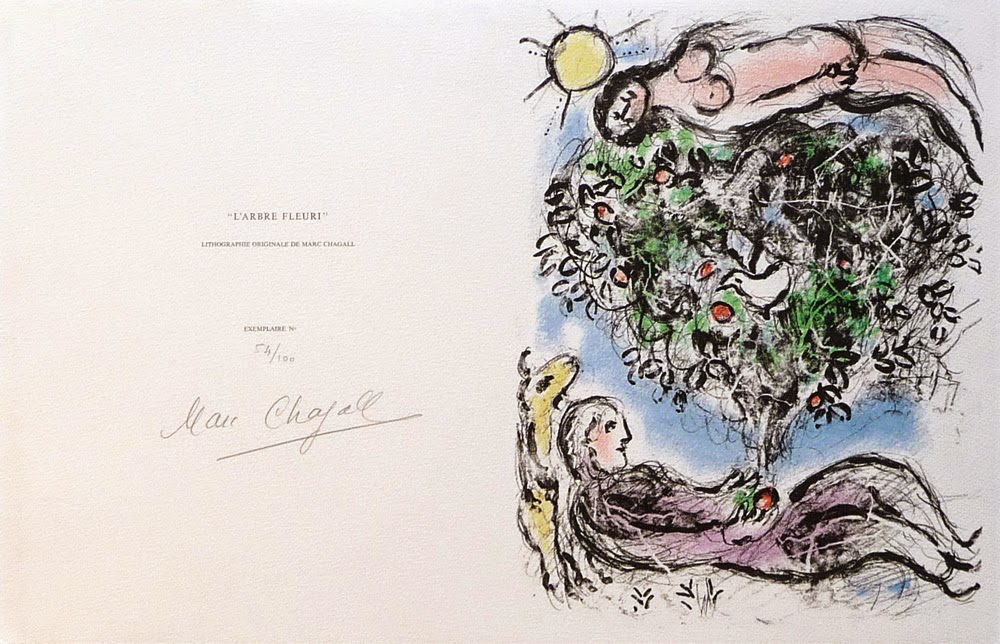
 
http://denisbloch.com/object.php/1285/marc-chagall-arbre-fleuri-lithograph-mourlot-915-louvre-catalogue
Marc Chagall "L'Arbre Fleuri I" - Lithograph - Edition of 100

When an artist prints a limited edition original print, such as a: lithograph, etching, aquatint, carborundum, screenprint, linocut, or woodcut, a set number of identical prints are made. This set number is the "Edition Size," and these will generally be numbered sequentially and hand-signed by the artist. An edition size can vary from extremely small editions of 5 to large editions of 1,000 or more. Open editions have an unknown or unlimited quantity of prints.


http://denisbloch.com/object.php/1104/joan-miro-la-magie-quotidienne-dupin-271-etchings-for-sale
Joan Miro "La Magie Quotidienne" - Etching - Edition of XV on Japon

Sometimes there are different editions printed on different kinds of paper. As an example there may be a regular edition on Arches paper with a limit of 100. These 100 prints are signed and numbered sequentially from 1/100 to 100/100.  In addition to this edition on Arches paper, a smaller edition of 15 are printed on Japon paper and numbered sequentially in roman numerals from I/XV to XV/XV and signed by the artist. This brings our total edition, to 115 prints + any additional proofs that may exist.

So What is a Proof?


A proof is usually an identical print to the regular edition, that is printed at the same time - but is not part of the numbered sequence. This is known as a "Proof Aside from the Edition," and these may or may not be hand-signed by the artist. In general with any edition printed there can be anywhere from 5-50 extra proofs aside from the edition.

Pablo Picasso "Farol (B. 945)" - Linocut - Epreuve d'artiste

Often these extra proofs are retained for the artist, otherwise known as an "Artist Proof". An artist proof can be annotated "A.P." for Artist Proof, or "E.A." in French "Epreuve d'artiste". Sometimes artists can additionally dedicate and gift a proof to a friend, collaborator, dealer, printer, or even family member.


Zao Wou-ki "En Attendant un Jour de Fete (250b)" - Etching - BAT with notes
A "Printer's Proof" designated as "P.P." is much the same, an extra proof made aside of the numbered edition retained by the printer or atelier. The "P.P." can also sometimes stand for "Publisher's Proof". The printer's proof is usually for approval by the master printer to ensure the quality of the printing, and can sometimes include notes and annotations about the printing process. The "BAT" or "Bon à Tirer" is a kind of printer's proof, normally use as a control example against which the other impressions are compared. Bon à Tirer is French for "Good to Print" and is also kept by the Printer or Atelier studio.


Sam Francis "Untitled I (TP)" - Etching - Color Trial Proof

 
Another kind of proof is the "Trial Proof" annotated "T.P." The trial proof is essentially a test proof, often to test colors or the final look of the composition. It is sometimes also referred to as a "working proof" by which the final composition of an edition has not yet been realized. Trial proofs are often thought of as unique prints as they are a one-of-a-kind version of the composition. Art historians, curators, and collectors view working proofs as especially desirable because of their rarity, and the insight they may give into the progress of the work.

http://denisbloch.com/object.php/556/marc-chagall-le-peintre-devant-le-village-mourlot-604
Marc Chagall "Le Peintre devant le Village II" - Lithograph - HC aside from edition

The last form of a "Proof" is the "H.C." which stands for the French term "Hors Commerce" or "Not for Sale". These are exactly as they sound, identical proofs to the regular edition that are not intended to be sold. Prints designated H.C. are often given to the project collaborators as a form of appreciation or partial payment.

Total Tirage

Marc Chagall Catalogue Raisonne Description

"Tirage", the French term meaning "output," is the total number of prints printed for an edition, including any proofs, APs, PPs, HC, and TPs. It is important to note that not every limited edition includes all of these, and the complete number of prints within a tirage are usually described in the artist's Catalogue Raisonné. Some artists and editions are catalogued very well and include full descriptions of the tirage, while others may have basic information only about the numbered edition.


For more information about printmaking and collecting original prints please visit our website:


Friday, June 20, 2014

Art Terms Decoded: What does "Stoned Signed" or "Plate Signed" Mean?

Andy Warhol "Marilyn Monroe Castelli Invitation" signed in felt pen.
 
As you begin to delve deeper into the world of fine art collecting you will find that one of the most important indicators of value and potential worth is the artist's signature. Some might even say that this is the most important aspect of an artwork that makes it a desirable luxury commodity.

The reasoning behind the incredible value of the artist's signature above all else, is that a signature is the easiest way to determine the authenticity of a work of art. Many have tried to fake the signature of the great master artists throughout time and sometimes people are fooled - but often expert art dealers, gallerists, curators and appraisers are able to catch a fraudulent mark. A fake signature automatically calls in question the authenticity of the work itself whether it is a painting or original
print.
 

Picasso "Le Vieux Roi" hand-signed in Blue
Picasso "Le Vieux Roi" Plate Signed in Red

From a pure collectorship stand point a hand-signed artwork is going to be the most valuable investment. That is not to say that an unsigned artwork does not have value, it just means the MOST valuable artworks are hand-signed ones.
 
Picasso "Ronde de la Jeunesse" Signed in the Stone
So this brings us to our term "Plate Signed" sometimes also known as "Stone Signed". A plate signed work is specifically referring to an original print or graphic on paper with a printed signature. This is precisely what it sounds like; a plate signature is a signature that is part of the composition and is printed along with the art image. As an example scenario: Pablo Picasso draws an etching composition onto a metal plate - he then signs the plate and dates it - the plate is inked and pressed onto paper and along with his etching Picasso's signature is printed. This would be a "plate signed" original etching.
 
The term "stone signed" is exactly the same but specifically references the stone slabs that might have been used to create an original lithograph. Sometimes artist catalogue raisonnes reference that an edition is "sign in the stone," which is also the same. 
 
The most important take-away in terms of collecting a plate or stoned signed artwork is that it is not equivalent to a hand-signed work and should be valued as such.
 
You can see more of our hand-signed, plate signed, and stoned signed original prints on our website:

Saturday, June 14, 2014

Art Terms Decoded - What does "Acid Free" Mean?

Pablo Picasso Linocut - Perfect Margin Conditions

Have you ever bought an original art print and encountered the term "Acid Free"?  Probably your art dealer or framer mentioned it? Well here is a useful definition of this important art term to give you some insight into protecting and preserving your fine art print investments:

Example of Acid Burn from non-archival framing


The term "Acid Free" refers to the materials used to frame an original artwork. When you frame a work of art - particularly a work on paper you must be extremely careful about the framing materials. Cardboard or regular tape have acidic properties that will eventually over time "burn" the paper or canvas that is exposed to them. The exposure to acidic matting, paper, or even storage materials causes a brown discoloration and deterioration of the paper. Many times the discoloration may occur underneath a frame and cannot be seen.
Pablo Picasso Etching with acid mat burn

When an artwork has been exposed to acidic materials and discolored it seriously devalues the piece. As mentioned in previous posts the investment quality of an artwork is heavily determined by the excellent condition of the piece. That is not to say that a damaged piece has no value, sometimes prints can be restored by a professional paper conservator depending on the level of damage, however this can be an expensive process.

To safely protect your fine art prints and artworks specify to your framer that you want only Acid Free or Archival matting, backboard, and hinging. We additionally recommend UV protective plexi-glas to further preserve your artwork.


For More Information on Art Conservation and Professional Art Terms visit our website: www.denisbloch.com/art_terms.php
 
We also welcome comments and questions regarding archival acid free preservation!
 
info@denisbloch.com / 310-270-4880